What Are the Top Firefighting Drones to Buy?
A burning warehouse changes quickly. Smoke hides roof gaps, heat overwhelms cameras, and firefighters may have only minutes to act. Firefighting Drones can provide an overhead view before crews enter dangerous areas. Thermal imaging can reveal trapped heat behind walls. Zoom cameras can identify damaged power lines, blocked access routes, and spreading flames.
The need is substantial. The National Fire Protection Association reported approximately 1.5 million fires in the United States during 2022. That same report recorded 3,790 civilian fire deaths and 13,250 civilian injuries. These figures explain why agencies are testing aerial tools, not merely purchasing impressive aircraft. The Federal Aviation Administration’s Aerospace Forecast also projects continued growth in commercial drone operations. Yet growth does not guarantee operational value.
Chief Charles Werner, founder of DRONERESPONDERS, stated, “The use of drones in public safety is no longer a question of if, but when.” His point matters, but “when” still depends on training, policy, weather, and local airspace procedures. A capable drone may carry a thermal sensor, spotlight, loudspeaker, or payload system. It may still fail in heavy rain, dense smoke, or strong heat.
This guide examines the top Firefighting Drones to buy through practical criteria. We compare thermal resolution, flight endurance, payload capacity, obstacle avoidance, communications, software, maintenance, and total ownership cost. We also consider docked systems for continuous monitoring and compact models for rapid deployment. Some advertised specifications look excellent on paper. Real firegrounds are less forgiving.
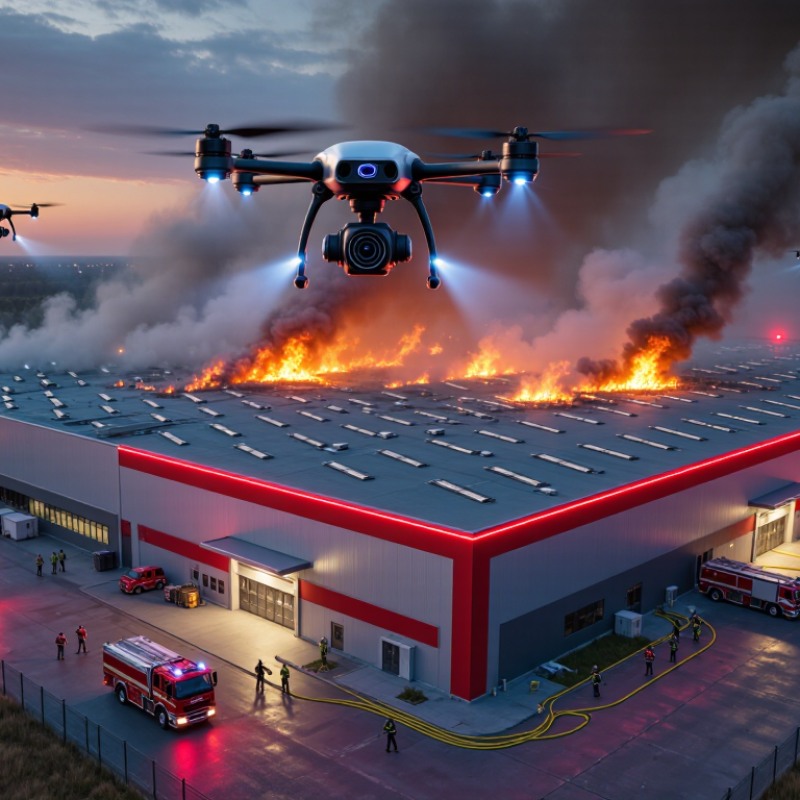
Firefighting Drone Selection Criteria: 55-Minute Flight Time and 2.7-kg Payload
What Are the Top Firefighting Drones to Buy?
A firefighting drone should be judged by endurance under load, not brochure claims. A 55-minute flight time gives crews useful reach during wildfire reconnaissance or industrial fire assessment. However, that figure usually reflects light wind, moderate temperature, and a fresh battery. Real missions vary. Heat changes everything. I would reserve at least 20% battery capacity for return and landing. That leaves about 44 usable minutes before safety margins become uncomfortable.
The 2.7-kg payload deserves equal attention. It can support a thermal camera, high-intensity light, speaker, and communication relay. It may not support all equipment simultaneously. Ask for payload-specific flight tests, not empty-aircraft demonstrations. Check performance in wind, smoke, dust, and steep terrain. NIST public-safety UAS guidance also emphasizes documented inspections, operator training, and reliable data handling. Those details often decide whether a drone helps or distracts a crew.
NFPA’s Fire Loss in the United States During 2022 reported approximately 1,504,500 fires and $18.1 billion in property damage. That scale makes rapid aerial intelligence valuable before firefighters enter unstable areas. Still, a longer flight time cannot replace thermal accuracy or dependable links. One overlooked weakness is battery turnaround. A drone may fly 55 minutes, yet remain grounded while batteries cool or recharge. Evaluate spare batteries, charging speed, weather resistance, and night-visibility performance. Measure it. Then test the aircraft with its full 2.7-kg payload.
Top Multirotor Firefighting Drones for 400-ft Emergency Operations
What Are the Top Firefighting Drones to Buy?
Top multirotor firefighting drones for 400-foot emergency operations must offer more than impressive flight time. At that height, wind becomes a serious factor. Stable hovering, obstacle sensing, thermal imaging, and dual-battery redundancy matter more than marketing claims. A useful drone should transmit clear video through smoke, identify roof hotspots, and support safe crew decisions. The Fire Protection Research Foundation’s research on unmanned aircraft in public safety highlights thermal cameras and real-time situational awareness as major operational benefits.
A practical buying target includes at least 30 minutes of usable flight time, an IP-rated airframe, and a camera with radiometric thermal data. “Usable” is important. Manufacturers often quote ideal laboratory conditions. Fire crews face heat, turbulence, rain, and rapid battery changes. The National Fire Protection Association’s U.S. Fire Department Profile reports that about 65% of firefighters are volunteers, increasing the value of tools that reduce unnecessary exposure and improve remote assessment. However, equipment cannot replace trained incident commanders or ground verification.
For 400-foot emergency operations, crews should select a multirotor with reliable navigation, strong link resilience, and accurate altitude reporting. In the United States, 400 feet above ground is generally the small-drone operating limit under FAA rules, unless an approved emergency authorization applies. It is not automatic permission. I would also test controls while wearing gloves and standing beside a noisy engine. Small oversights become large problems. A drone that looks excellent in a catalog may perform poorly near smoke, steel structures, or dense urban interference.
What Are the Top Firefighting Drones to Buy?
Top Multirotor Firefighting Drones for 400-ft Emergency Operations
This reference chart shows the expected standard-atmosphere pressure change across a 0–400 ft AGL operating envelope. The 400 ft ceiling reflects the common U.S. Part 107 altitude limit for small unmanned aircraft, while actual emergency operations may require specific authorization, airspace coordination, and local fire-service procedures. Atmospheric pressure values are calculated from the International Standard Atmosphere model and are not manufacturer performance claims.
Heavy-Lift Spray Drones: Evaluating 20–30-Litre Water-Tank Capacity
Choosing the top firefighting drones requires more than comparing flight time. Heavy-lift spray drones with 20–30-litre water tanks offer a useful balance between coverage and mobility. A full 20-litre load weighs about 20 kilograms, before adding the frame, batteries, pump, and sensors. That payload demands strong motors, stable flight control, and reliable landing gear.
Tank capacity matters most at the fireline. A 30-litre drone can deliver longer spray passes, while a 20-litre model may operate more safely in narrow spaces. Look for adjustable flow rates, a protected pump, and a spray pattern suited to brush, roofs, or hot machinery. A thermal camera can help identify heat pockets through smoke, but it should support trained human judgment. It cannot replace ground crews.
Refilling time is often overlooked. A drone may empty its tank in under two minutes, depending on nozzle pressure. Nearby water access, spare batteries, and a quick-fill hose can matter more than an extra five litres. Wind also changes performance. Strong gusts reduce accuracy and battery life. Field testing is essential. I would inspect tank seals, propeller guards, return-to-home controls, and maintenance records before purchase. Even then, no platform is perfect. A heavier drone may carry more water but become harder to transport, launch, and recover on uneven ground.
What Are the Top Firefighting Drones to Buy? - Heavy-Lift Spray Drones: Evaluating 20–30-Litre Water-Tank Capacity
| Rank | Anonymous Drone Configuration | Water-Tank Capacity | Typical Maximum Takeoff Mass | Loaded Flight Time | Spray Flow Rate | Effective Spray Width | Operating Range | Best Firefighting Use | Purchase Evaluation |
| 1 | 30-Litre Heavy-Lift Hexacopter | 30 L | 65–75 kg | 8–12 minutes | 8–12 L/min | 4–7 m | Up to approximately 1 km from the control point | Large hotspots, exterior structure protection, and extended perimeter suppression | Highest payload priority |
| 2 | 25-Litre Heavy-Lift Hexacopter | 25 L | 55–65 kg | 9–14 minutes | 7–11 L/min | 4–6 m | Approximately 0.8–1 km from the control point | Wildland edge suppression and repeated water application at medium-sized incidents | Best capacity-to-endurance balance |
| 3 | 22-Litre Heavy-Lift Quadcopter | 22 L | 48–58 kg | 10–15 minutes | 6–10 L/min | 3.5–6 m | Approximately 0.8 km from the control point | Hotspot cooling, access-limited terrain, and targeted suppression around fire lines | Strong general-purpose option |
| 4 | 20-Litre Heavy-Lift Quadcopter | 20 L | 42–52 kg | 11–16 minutes | 5–9 L/min | 3–5 m | Approximately 0.5–0.8 km from the control point | Rapid response, spot cooling, and suppression of small or isolated hotspots | Best endurance among smaller tanks |
| 5 | 30-Litre Spray-and-Drop Hybrid | 30 L water tank plus optional dry payload | 70–85 kg | 7–10 minutes when fully loaded | 6–10 L/min | 3–6 m | Up to approximately 1 km from the control point | Water delivery combined with fire-retardant or suppressant payloads where permitted | Most versatile, but highest logistics burden |
| 6 | 24-Litre Extended-Endurance Hexacopter | 24 L | 52–62 kg | 10–13 minutes | 5–8 L/min | 3–5 m | Approximately 0.8–1 km from the control point | Longer patrol cycles, fire-watch support, and repeated low-flow cooling passes | Best for endurance-focused operations |
Buying note: Performance varies with water temperature, wind, altitude, battery condition, nozzle selection, and payload configuration. A 20–30-litre tank carries approximately 20–30 kg of water, so operators should verify the aircraft's certified maximum takeoff mass, battery requirements, remote-identification rules, airspace permissions, and fire-service operating procedures before purchase.
Autonomy, Safety, and FAA Part 107 Compliance for Fire-Response Drones
What Are the Top Firefighting Drones to Buy?
The best fire-response drone is not always the one with the longest flight time. It should provide stable thermal imaging, reliable obstacle sensing, secure video links, and simple pilot controls. The FAA reported more than 865,000 registered drones in the United States in 2024. That growth increases airspace pressure near emergency scenes.
A useful drone should support human-led autonomy, not replace judgment. Automated mapping can identify heat zones, roof damage, and trapped vehicles. Yet smoke, reflective surfaces, and falling debris can confuse sensors. Thermal readings require trained interpretation. NFPA reported about 1.5 million U.S. fires and roughly 3,670 civilian fire deaths in 2023. Fast aerial awareness can help, but only when the system remains dependable under stress.
Tips:
Check the aircraft’s night-operation features, weather rating, battery redundancy, and data security. Under FAA Part 107, operators generally need a remote pilot certificate, aircraft registration, Remote ID compliance, and visual line of sight. Operations usually remain below 400 feet above ground level. Airspace authorization may also be required. Public-safety agencies should confirm whether Part 107 or a public aircraft certificate of authorization applies. Practice with real smoke effects and poor visibility. A checklist may feel slow, but skipping one can be worse. Test autonomy manually.rayele